Siemens Healthineers unveils AI-powered imaging chain
Siemens Healthineers has introduced Optiq AI, an artificial intelligence-powered imaging chain designed to enhance image quality whilst maintaining low radiation doses during image-guided interventional procedures. The technology was presented at the Radiological Society of North America (RSNA) Annual Meeting in Chicago.
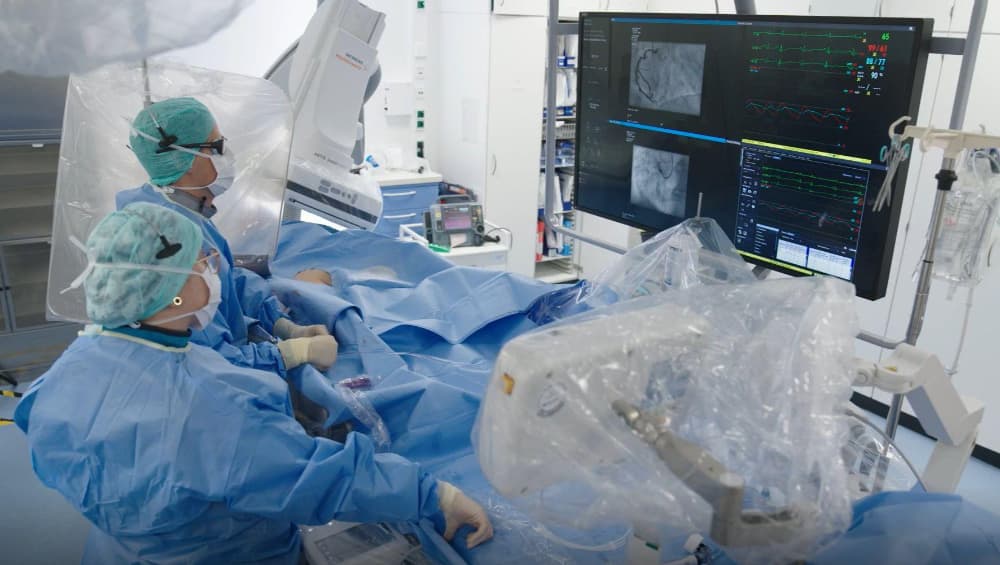
Professor Samuel Tobias Sossalla, MD, director of cardiology at Kerckhoff Clinic Bad Nauheim and University Clinic Gießen, Germany, is working with the new Artis icono.explore floor with Optiq AI.
The new imaging chain addresses growing complexity in image-guided therapy, where precision requirements for early-stage treatments and minimally invasive procedures demand superior image quality without compromising patient and staff safety. Optiq AI will be integrated across three new imaging platforms: Artis genio, Artis icono.explore, and Artis icono.vision/Artis pheno.vision.
Real-time denoising through AI algorithms
Optiq AI employs an AI-based algorithm that reduces noise introduced during image formation, including electronic interference, in real time. This denoising capability benefits multiple two-dimensional imaging modes, encompassing fluoroscopy, acquisition, and digital subtraction angiography across interventional radiology, cardiology, and minimally invasive surgery applications.
The system utilises big data to automatically optimise parameter combinations based on user-specified imaging requirements. Its exposure control dynamically adjusts tube voltage, tube current, copper prefiltration, focal spot size, pulse width, and detector dose whilst accounting for source-image distance and collimation. When system repositioning or parameter modifications occur during procedures, Optiq AI automatically recalibrates to maintain requested image quality whilst keeping radiation doses as low as reasonably achievable.

Clinical validation and system integration
“The growing need for earlier-stage treatments raises the bar for image quality and this is where artificial intelligence comes into play,” explains Carsten Bertram, head of Advanced Therapies at Siemens Healthineers. “With Optiq AI, we are unlocking AI’s potential for a new generation of interventional systems and are bringing it to all clinical fields. Clinical staff and their patients benefit from accelerated workflows and better image quality, paving the way for precision therapy.”
Early clinical experience has been positive. Professor Samuel Tobias Sossalla, MD, director of cardiology at Kerckhoff Clinic Bad Nauheim and University Clinic Gießen, Germany, and his colleagues have worked with the new Artis genio floor and Artis icono.explore floor equipped with Optiq AI for five months. “You can really see a major breakthrough,” he said. “AI-based noise reduction gives us razor-sharp images of very high quality, which are excellent to work with.”
Platform specifications
The technology launches across Siemens Healthineers’ latest interventional system range. High-end platforms Artis icono.vision and Artis pheno.vision prioritise speed and precision, whilst Artis icono.explore features a powerful X-ray tube for high patient throughput. Artis genio is engineered for versatility and productivity across diverse case mixes.
Regulatory status: Optiq AI, Artis icono.explore floor, and Artis genio floor are pending 510(k) clearance and are not yet commercially available in the United States. Outside the United States, Optiq AI, Artis icono.explore floor, and Artis genio floor are under development and not commercially available. Artis icono.vision and Artis pheno.vision are under development globally.
- For more information, visit: https://www.siemens-healthineers.com