Novel first-in-class antibodies block inflammation pathway in autoimmune diseases
Researchers at UMC Utrecht have developed two novel antibodies that specifically target the high-affinity IgG receptor FcγRI, offering a potential therapeutic approach for autoimmune diseases including rheumatoid arthritis, systemic lupus erythematosus, and immune thrombocytopenia. The antibodies, designated C01 and C04, effectively block immune complex binding without triggering receptor activation, addressing a key limitation of previous anti-FcγRI therapeutics.
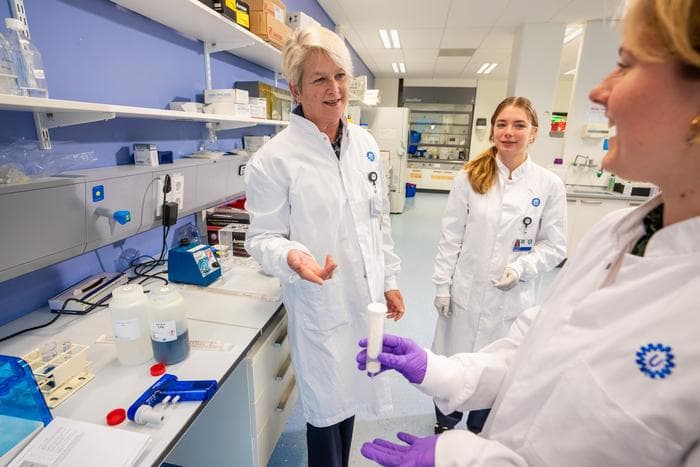
Prof. Jeanette Leusen, PhD (left) and colleagues at the Center for Translational Immunology (UMC Utrecht) © Ed van Rijswijk
Overcoming three decades of therapeutic challenges
For more than 30 years, the scientific community has struggled to develop effective antibodies against FcγRI (also known as CD64), a crucial receptor involved in immune responses. The receptor’s exceptionally high affinity for IgG antibodies made conventional approaches unsuccessful. An international research team led by Professor Jeanette Leusen at UMC Utrecht’s Centre for Translational Immunology has now achieved this long-sought breakthrough.
“I think we found the needle in the haystack, after searching over a decade and thanks to a true team effort,” explains Professor Leusen. “Each research partner contributed a critical piece, from antibody discovery and structure determination to patient sample testing and preclinical models. Only together could we bring this to fruition.”
The research, conducted by PhD candidate Tosca Holtrop and published in Nature Communications on 19 November 2025, represents a collaborative effort involving researchers from Kiel University, Leiden University Medical Centre, Utrecht University, and Friedrich-Alexander University Erlangen-Nürnberg.
Innovative discovery methodology
The research team employed a novel combination of the UMAB unique immunisation method with advanced phage display antibody libraries. This approach allowed them to bypass traditional obstacles by excluding the Fc region of antibodies during the selection process. The result was the identification of two unique Fc-silent antibodies, C01 and C04, that bind exclusively via their Fab domains to FcγRI.
Crystal structure analysis revealed that C01 binds precisely within the IgG-binding site on extracellular domain 2 (EC2) of FcγRI, making simultaneous binding of IgG and the antibody impossible. This structural confirmation explains the antibodies’ exceptional blocking capacity.
Superior binding and blocking capacity
Quantitative binding studies demonstrated that both C01 and C04 possess higher affinity for FcγRI than human IgG itself. This superior binding enables them to efficiently displace existing IgG or pathogenic immune complexes, achieving up to 60% displacement and blocking up to 90% of new binding. The research authors note in their discussion: “C01 had the highest effective binding affinity for FcγRI, followed by C04, hIgG1, and 10.1, making C01 and C04 significantly better binders than hIgG.”
Critically, neither antibody triggered FcγRI activation—a crucial distinction from earlier anti-FcγRI antibodies that could inadvertently cause receptor clustering and cytokine release. This represents a significant safety advantage, as previous therapeutic attempts, such as with antibody H22 (MDX-33), were discontinued in clinical trials due to adverse inflammatory reactions.
Therapeutic validation in disease models
The therapeutic potential of C01 and C04 was validated through multiple disease-relevant models. In an in vitro immune thrombocytopenia model, both antibodies effectively inhibited the binding of opsonised platelets to immune cells from ITP patients. When tested in a preclinical in vivo ITP model using humanised immunodeficient mice, the antibodies significantly reduced IgG-dependent platelet depletion.
For rheumatoid arthritis applications, the antibodies demonstrated remarkable efficacy in inhibiting patient-derived autoantibody–immune complex binding to monocytes, macrophages, and neutrophils from healthy donors. In experiments with activated neutrophils from healthy donors, C01 blocked between 52.8% and 68.7% of monoclonal ACPA-IC binding and 58.1% to 70.2% of patient-derived polyclonal ACPA-IC binding, depending on concentration. The effects showed clear dose dependency, with higher concentrations providing enhanced blocking.
Mechanism of action and structural insights
The crystal structure of the C01-FcγRI complex provided detailed mechanistic understanding. Of the 17 residues in the C01 epitope, 14 overlap with those involved in Fc binding, including key residues Phe146, His148, and Trp149. The authors explain: “C01 inhibits Fc binding to FcγRI by overlapping binding sites and steric hindrance.”
Importantly, structural analysis revealed that C01 binding induces conformational changes in FcγRI, partially collapsing the unique hydrophobic pocket critical for high-affinity IgG-Fc binding. This mechanism prevents multivalent immune complexes from bridging multiple FcγRI receptors and forming the high-avidity clusters necessary for inflammatory signalling.
Clinical development pathway
The antibodies have been patented by Utrecht Holdings, and efforts are underway to identify partners for clinical development. Next steps include affinity maturation to further enhance blocking and displacement capabilities, as well as humanisation of the initially mouse-derived antibodies to reduce immunogenicity for clinical use.
The research team notes that these antibodies “not only provide a unique tool for studying FcγRI biology, but also hold promise as therapeutic candidates in autoimmune and infectious diseases.” The therapeutic approach may offer particular benefit for rheumatoid arthritis patients experiencing ongoing pain despite anti-inflammatory therapy, as FcγRI has been implicated in both joint inflammation and pain sensation through expression on nociceptive neurons.
Reference
Holtrop, T., Brandsma, A. M., Feitsma, L. J., et. al. (2025). Preclinical assessment of two FcγRI-specific antibodies that competitively inhibit immune complex-FcγRI binding to suppress autoimmune responses. Nature Communications, 16, 10068. https://doi.org/10.1038/s41467-025-65133-z