
Novel manganese-based MOF offers safer alternative to gadolinium MRI contrast
Researchers at Oregon State University have developed a novel manganese-based contrast agent for magnetic resonance imaging that demonstrates superior performance to current gadolinium-based agents whilst offering improved biocompatibility and reduced environmental concerns. The material, designated BVR-19, represents the first application of metal-organic framework technology incorporating the amino acid L-cystine for medical imaging applications.
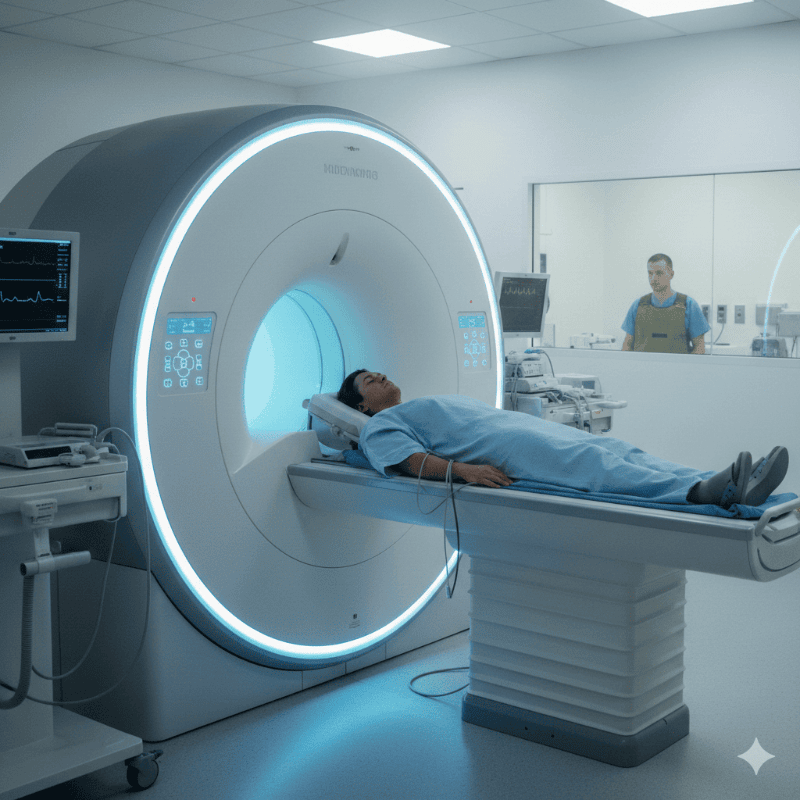
Metal-organic framework design addresses gadolinium limitations
Scientists led by Kyriakos Stylianou at OSU’s Materials Discovery Laboratory have designed BVR-19 as a direct response to long-standing concerns surrounding gadolinium-based contrast agents. Gadolinium, a rare earth element that has dominated MRI contrast imaging for nearly four decades, presents multiple challenges including patient toxicity risks, environmental persistence, and supply chain vulnerabilities linked to concentrated rare earth reserves in China.
The novel manganese-based metal-organic framework exploits the natural abundance of manganese in the Earth’s crust and its established role as an essential trace element in human metabolism. “BVR-19 represents a paradigm shift in MRI contrast agent design,” said Stylianou, who directs the laboratory. “We’re replacing toxic metals with abundant, biocompatible ones, without compromising performance.”
Enhanced imaging performance with improved safety profile
Testing of BVR-19 has demonstrated the material’s capacity to produce brighter, clearer images at lower doses compared with commercially available gadolinium-based agents. The synthesis process occurs in water at room temperature without requiring toxic solvents or harsh conditions, aligning with green chemistry principles.
The incorporation of L-cystine, a naturally occurring biocompatible amino acid, marks the first instance of this amino acid being utilised in a manganese-based metal-organic framework for imaging applications. This design choice contributes to the material’s favourable biocompatibility profile whilst maintaining the nanoscale porous structure characteristic of MOF materials.
Clinical and environmental implications
Current gadolinium-based contrast agents present documented retention issues, with the metal persisting in patient tissues for months or years even in individuals with normal kidney function. The Food and Drug Administration has issued warnings regarding uncertainty around long-term consequences, requiring patient education before administration.
Environmental concerns centre on gadolinium’s resistance to degradation in wastewater treatment facilities, with long-term ecotoxicological effects remaining poorly characterised. BVR-19’s design addresses both patient safety and environmental sustainability concerns inherent to current contrast agent technology.
Market context and collaborative development
The global MRI contrast agent industry currently holds an estimated value exceeding $1.5 billion, with projected growth of $750 million over the next five years driven by increasing demand for non-invasive diagnostic procedures.
The research, published in the Journal of Materials Chemistry B on 6 November 2025, involved doctoral student Jacob Lessard and undergraduate Dylan Pyle as first authors, with additional contributions from postdoctoral fellow Andrzej Gladysiak, doctoral student Emmanuel Musa, and undergraduate Jeff Bowen. The collaboration extended across disciplines, including toxicology expertise from Robyn Tanguay, Lisa Truong, and Siva Kolluri of OSU’s College of Agricultural Sciences, and contributions from Cory Wyatt at Oregon Health & Science University.
Oregon State University has filed a patent application covering BVR-19’s structure and related materials for biomedical imaging applications.
Reference
Lessard, J. M., Pyle, D., Gladysiak, A., et. al. (2025). Aqueous-stable Mn(ii)-MOF nanoparticles with high r1 relaxivity and biocompatibility: A novel T1 MRI contrast agent. Journal of Materials Chemistry B. https://doi.org/10.1039/D5TB01711D