
Non-invasive spinal stimulation restores stepping control in paraplegic patients
Researchers in Japan have developed a breakthrough non-invasive closed-loop spinal stimulation system that enables individuals with paraplegia to regain control of leg stepping movements. The hand-controlled magnetic stimulation technique bypasses spinal cord lesions and strengthens preserved neural circuits, offering a surgical-free alternative for gait rehabilitation after spinal cord injury.
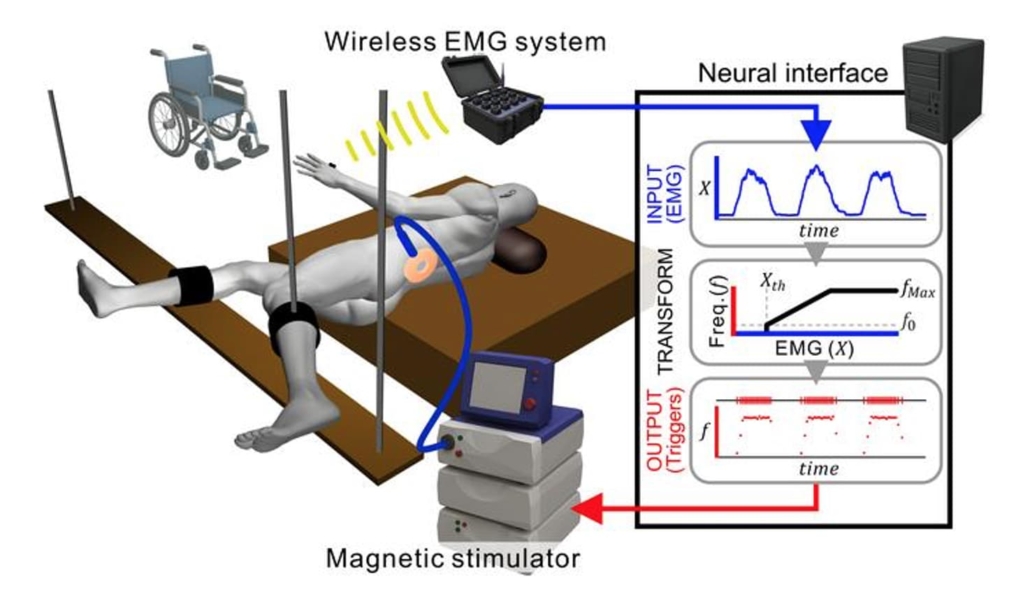
Schematic illustration of the noninvasive closed-loop spinal interface. Hand muscle activity is recorded by surface electrodes and converted into trigger pulses for magnetic stimulation applied over the lumbar spinal cord. This allows individuals with paraplegia to control stepping movements of their legs. © TMIMS
A research team led by Dr Yukio Nishimura at the Tokyo Metropolitan Institute of Medical Science has demonstrated that individuals with chronic spinal cord injury (SCI) can regain volitional control of bilateral leg stepping through a novel non-invasive closed-loop spinal stimulation paradigm. The system translates hand muscle activity into magnetic stimulation pulses targeting the lumbar spinal motor circuits, effectively creating an artificial neural connection that bypasses the lesion site.
The findings, published in Brain on 26 November 2025, represent a significant advance in SCI rehabilitation by offering a completely non-invasive alternative to surgical electrode implantation techniques currently used for spinal stimulation therapies.
Restoring neural pathways without surgery
The innovative system addresses a fundamental challenge in SCI-related paraplegia: the disconnection between intact supraspinal systems and preserved lumbar spinal motor circuits below the injury level. By recording electromyographic (EMG) signals from the first dorsal interosseous hand muscle and converting these into trigger pulses for transcutaneous magnetic stimulation over the lumbar vertebrae, the researchers established what they term an “artificial neural connection” (ANC).
Ten participants with chronic SCI were enrolled in the study, including five who underwent longitudinal experimental protocols involving repeated sessions over several months. The cohort included individuals with complete and incomplete injuries at both thoracic and lumbar levels, classified according to the American Spinal Injury Association Impairment Scale (AIS).
Precise control of stepping parameters
All participants achieved control over bilateral cyclic stepping through the ANC interface, regardless of lesion location or completeness of sensory and motor loss. The authors report in their paper: “Using hand muscle-controlled magnetic stimulation targeting the lumbar spinal motor circuits in the preserved lumber cord, individuals with chronic SCI achieved control of start–stop motion, step length and cadence of bilateral cyclic stepping in paralysed legs.”
The system enabled participants to initiate and terminate stepping movements, modulate step length by adjusting hand-gripping duration, and control stepping cadence. Cross-correlation analysis revealed alternating left-right leg coordination with phase differences approaching 180 degrees, characteristic of natural gait patterns.
Muscle activity recordings demonstrated asymmetric activation patterns in hip flexor and extensor muscle groups, with the predominant muscle activation corresponding to observed hip joint movements during stimulus-induced stepping. Importantly, catch-cycle experiments confirmed that stepping movements ceased when magnetic stimulation was withheld, demonstrating that the observed locomotor patterns resulted from spinal stimulation rather than passive mechanical responses.
Progressive improvements through repeated application
Longitudinal data from five participants who underwent multiple sessions over 8 to 40 weeks revealed progressive improvements in both stimulus-induced and voluntary stepping performance. Repeated ANC-controlled stepping trials within single sessions produced immediate enhancement of leg movement amplitudes and muscle responses, particularly in participants with thoracic SCI where lumbar circuits remained relatively intact.
The researchers observed that combining voluntary leg movement effort with ANC-controlled stimulation further enhanced stepping performance. “Combining voluntary gait effort with closed-loop stimulation further enhanced leg movements,” the authors state, suggesting summative effects of descending voluntary commands and spinal stimulation inputs on preserved lumbar motor circuits.
Crucially, stimulus-free voluntary stepping also improved over the course of repeated ANC sessions, though this effect was predominantly observed in participants with incomplete SCI who retained some descending pathway connectivity. Analysis of variance with generalised linear mixed-effects models demonstrated significantly greater improvement slopes in the incomplete SCI group compared with those with complete injuries.
Distinct mechanisms for different recovery pathways
The differential responses between participants with thoracic versus lumbar lesions, and between complete versus incomplete injuries, revealed important mechanistic insights. Improvements in ANC-controlled stepping were most pronounced in participants with thoracic SCI, suggesting that preservation of lumbar spinal motor circuits is critical for plasticity induced by repetitive stimulation.
Conversely, recovery of natural voluntary stepping without stimulation was observed primarily in participants with incomplete injuries, regardless of lesion level. The authors conclude: “Our findings indicate that the preserved lumbar spinal motor circuit plays a crucial role in improving stimulus-induced stepping, whereas the preserved descending pathway is required for improving stimulus-free stepping.”
Clinical implications and future directions
The non-invasive nature of this approach addresses a significant barrier to clinical translation of closed-loop spinal stimulation technologies. As the authors note: “This approach holds great promise for SCI-related gait rehabilitation because it has the potential to lead to functional recovery. Furthermore, this approach offers a viable alternative for individuals with contraindications to invasive procedures or those who do not consent to surgical treatments.”
The system’s intuitive control strategy, requiring only a single surface EMG channel and employing a straightforward linear algorithm, eliminates the need for complex decoder calibration whilst maintaining biomimetic activity-dependent stimulation patterns conducive to neural plasticity.
Whilst no participants achieved independent overground ambulation, one participant with incomplete thoracic SCI progressed to performing forward stepping whilst standing with full body weight support and long-limb orthoses after 17 sessions, demonstrating clinically meaningful functional gains.
Future work will need to establish optimal training parameters, including session frequency, duration and overall treatment periods, as well as investigating the approach’s efficacy for overground locomotion in ambulatory individuals with SCI.
Reference
Tazoe, T., Sasada, S., Murayama, T., et. al. (2025). Non-invasive closed-loop spinal stimulation restores leg stepping control in humans with paraplegia. Brain, awaf230. https://doi.org/10.1093/brain/awaf230